How to Stop Video Game Addiction in Kids
If your child gets angry when games stop, hides play time, or loses interest in school and offline activities, this is usually a control problem, not a motivation problem. This guide shows how to stop video game addiction in kids and how to prevent relapse with a clear parent system.
Start in 15 minutes: install controls, block game access, set daily limits, and review logs once a week.
14-day free trial. No credit card.
HT Parental Controls helps enforce rules on a child’s PC without daily arguments and constant manual checks.
What Video Game Addiction Looks Like in Real Life
Many parents notice the problem only after grades drop or sleep gets worse. Early signs usually appear in behavior first, then in routine and school performance.
Behavior Signs
- Irritability or aggression when gaming is interrupted
- Frequent lying about game time
- Loss of interest in sports, hobbies, or family activities
- Constant negotiation to extend gaming sessions
Routine Impact
- Sleep delay and morning fatigue
- Homework avoidance or rushed schoolwork
- Skipping meals or reduced physical activity
- Playing outside agreed hours or in secret
Why Kids Get Hooked So Fast
Games combine rewards, social pressure, rankings, and endless progression. For a developing brain, this is a powerful loop: effort, reward, repeat. Kids are not weak, and parents are not failing. The system is designed to maximize time spent in-game.
The goal is not to ban all games forever. The goal is to keep gaming in a healthy place: after responsibilities, within limits, and without damage to sleep, learning, or family relationships.
Parent Action Plan (Simple and Practical)
- Set non-negotiable rules: define allowed hours, school-day policy, and device-off time.
- Separate “Block” and “Limit” use cases: block harmful access, limit acceptable gaming windows.
- Cover both channels: browser games and installed games need different controls.
- Review weekly: check what changed, then adjust rules and schedules.
- Keep communication open: explain rules as health boundaries, not punishment.
First 24 Hours: Quick Reset for Parents
If conflict is already high, do not start with a long lecture. Start with structure and predictable rules.
Hour 1
Tell your child the new baseline: sleep and school come first, games are scheduled.
Hour 2
Apply technical limits for browser games and installed games.
Day 1 Evening
Run a short review: what worked today and what rule needs adjustment.
How to Stop Video Game Addiction in Kids: Practical Sequence
- Define clear house rules: set fixed gaming windows, homework-first, and sleep-first boundaries.
- Reduce immediate triggers: block high-risk game access during school and evening hours.
- Replace, not only remove: add offline alternatives (sports, hobbies, social time).
- Review weekly patterns: adjust limits based on behavior, sleep, and school outcomes.
To prevent video game addiction, consistency matters more than strictness: small rules, applied every day, work better than short-term hard bans.
Replace, Not Just Remove: Build Better Screen Habits
Pure restriction often creates resistance. A stronger long-term strategy is to replace part of passive gaming with active creation.
- Keep a small game window in the schedule, instead of full bans.
- Add one "creation block" per week (coding, design, robotics, music, writing).
- Use guided learning pages your child can complete and show you.
Use this structured guide to switch screen time from consumption to skills: Coding for Kids: Easy Steps for Parents.
How to Set Game Limits on PC with HT Parental Controls
Use direct installer flow, then configure rules in two places.
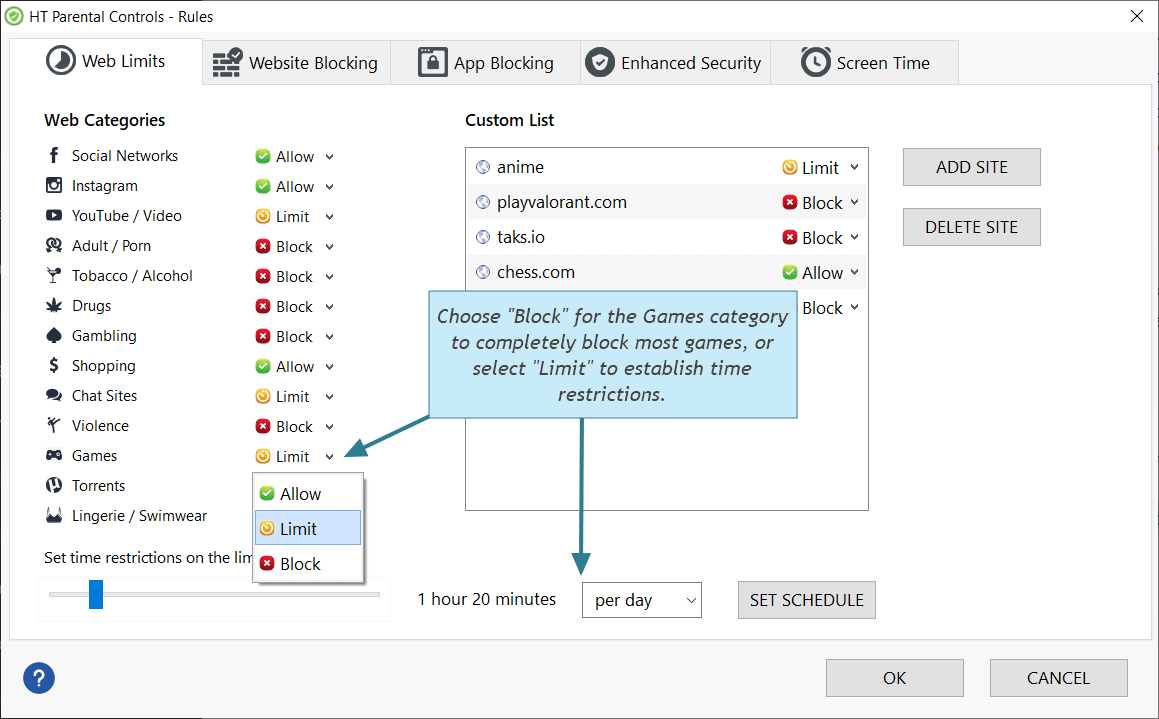
1Block Online Game Websites
- Download HT Parental Controls and install it on the child’s PC.
- Open Rules → Website Limits.
- Set Games = Block or use Limit for scheduled access.
- Add missed websites to the Custom List.
Click to enlarge
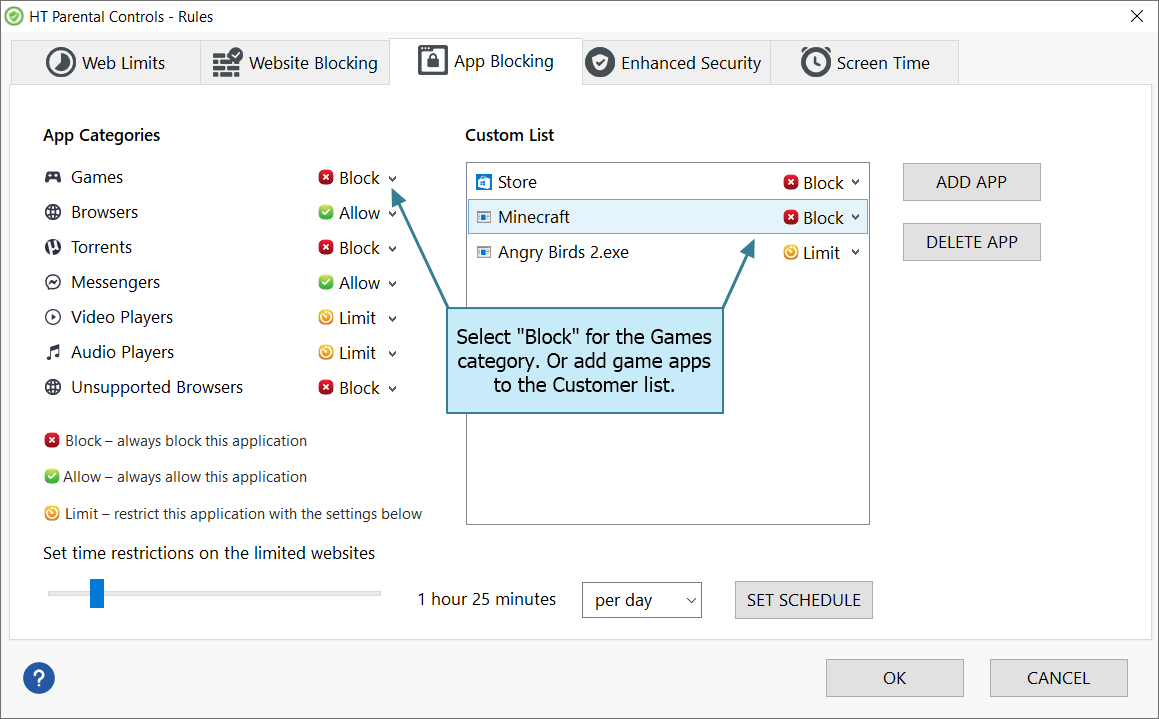
2Block Installed Game Apps
- Open Rules → App Blocking.
- Set Games = Block or Limit.
- Add specific game executables via Add App or Browse.
- Use reports to block new games immediately when they appear.
Click to enlarge
This same setup works for school and university computer labs where administrators need to reduce gaming distractions during study hours.
Common Mistakes That Make the Problem Worse
- 🗣️ Only talking, no enforcement: verbal rules without technical limits fail quickly.
- 🌐 Only blocking websites: installed games stay active unless app rules are set too.
- 🔁 No review cycle: new games appear and bypass old settings.
- 🚫 All-or-nothing approach: unrealistic bans create stronger resistance and secrecy.
FAQ: Video Game Addiction and Game Limits
Take the First Step Today
You do not need a perfect plan. You need a repeatable system: rules, technical enforcement, and short weekly reviews. Families that win this problem are consistent, not extreme.
Get a 14-day free trial — no credit card required.
Last updated: February 20, 2026